Real Money Casino Table Games in Australia
 Available in AU
A clear guide to online, live dealer and local casino tables, with the legal position explained before game comparisons.
Table of Contents
- Australia’s Rules for Real-Money Online Table Games
- The Table Games Found on Online Casino Platforms
- Live Tables, Local Casinos and the “Near Me” Question
- Which Table Games Offer the Strongest Mathematical Position?
- Dealer Pay and the Systems Behind Casino Tables
- House Edge: Reading a Table-Game Comparison
- Free Table-Game Demos Without a Download
- Bitcoin Table Games Compared with Conventional Casino Tables
- Pai Gow Poker: Where It Fits Among Table Games
- How Canadian Table-Game Casinos Differ from the Australian Position
Australia’s Rules for Real-Money Online Table Games
The legal position comes before the choice of blackjack, roulette or any other casino table game. In Australia, the Interactive Gambling Act 2001 makes it illegal for companies to offer online casino services to Australian residents. The prohibition covers online casino table games and live dealer tables, as well as online poker. An Australian business cannot lawfully provide real-money online casino games to customers in Australia.
This creates a distinction that is easy to miss in commercial search results. The absence of a domestic online casino licence is not an invitation to look for a different Australian-licensed operator. No Australian gambling licence exists for casino games because offering that product to Australian residents is against the law. Licensed Australian wagering services are limited to products such as sports and race betting, which do not change the legal treatment of online casino games.
What the law targets
The Interactive Gambling Act targets the provider rather than the individual player. Australians are not committing a crime merely by placing a bet at an offshore casino, and there is no law making it illegal for an individual to play at such a site. That point does not turn offshore play into a licensed Australian service. It only separates the player’s position from the operator’s position.
This page highlights key facts for Australians exploring real-money casino table games in 2026. Use the overview to check each operator’s licensing details, promotions, deposit requirements, or payout information where available.
License: Curacao eGaming OGL/2024/923/0383 (Antillephone N.V.) · Bonus: up to A$2,000 + 100 free spins across 2 deposits · Min. deposit: A$30 WinSpirit Casino holds a Curacao eGaming licence, OGL/2024/923/0383, issued through Antillephone N.V. Its offer includes up to A$2,000 and 100 free spins across two deposits, with a minimum deposit of A$30.
License: Curacao eGaming (Roby Games Ltd) · Bonus: 100% up to A$750 + 200 free spins Roby Casino operates under Curacao eGaming through Roby Games Ltd. Its listed promotion is 100% up to A$750 plus 200 free spins.
License: Curacao eGaming Licence · Min. deposit: A$10 PlayCroco is listed with a Curacao eGaming licence and has a minimum deposit of A$10.
License: Curacao eGaming Licence · Min. deposit: A$10 Fair Go Casino holds a Curacao eGaming licence. Its minimum deposit is A$10.
Bonus: 100% up to A$750 + 200 free spins, 35x wagering · Payout speed: crypto 30-120 minutes, fiat 24-72 hours · Min. deposit: A$30 MrPacho offers a 100% bonus up to A$750 plus 200 free spins, with 35x wagering. Crypto payouts are listed at 30–120 minutes and fiat payouts at 24–72 hours, while the minimum deposit is A$30.
License: Curacao · Bonus: up to A$10,000 multi-stage + 500 free spins · Min. deposit: A$20 (POLi) Lucky Dreams is licensed in Curacao and advertises a multi-stage bonus of up to A$10,000 with 500 free spins. The minimum POLi deposit is A$20.
License: Curacao eGaming (Hollycorn N.V., since 2017) · Bonus: 225% up to A$1,540 + 600 free spins across 4 deposits, 20x wagering · Min. deposit: A$20-30 (depends on the offer) Playfina Casino operates under Curacao eGaming through Hollycorn N.V., which has held the licence since 2017. Its offer includes 225% up to A$1,540 and 600 free spins across four deposits, with 20x wagering and a minimum deposit of A$20–30 depending on the offer.
License: Curacao eGaming (Dama N.V.) · Bonus: up to A$10,000 + 180 free spins, 40x wagering JeetCity Casino is licensed by Curacao eGaming through Dama N.V. Its promotion offers up to A$10,000 plus 180 free spins, with 40x wagering.
License: Curacao Gaming Control Board OGL/2023/176/0095 (Hollycorn N.V.) · Bonus: 100% up to A$10,000 + 100 free spins GoldenCrown holds a Curacao Gaming Control Board licence, OGL/2023/176/0095, through Hollycorn N.V. Its listed promotion is 100% up to A$10,000 plus 100 free spins.
Bonus: up to A$750 + 50 jackpot spins, 35x wagering · Payout speed: crypto ~90 minutes, fiat 1-5 days · Min. deposit: A$30 Kingmaker offers up to A$750 plus 50 jackpot spins, with 35x wagering. Crypto payouts are listed at around 90 minutes and fiat payouts at 1–5 days, with a minimum deposit of A$30.
The company offering online casino table games to an Australian customer is the party exposed to the prohibition. The customer remains outside the offence described above, but also remains outside the protection that would come with Australian regulatory supervision. Offshore sites are not on a licensed Australian footing.
The Australian Communications and Media Authority can investigate illegal offshore gambling sites and request that internet service providers block them. A blocked site may therefore become inaccessible from Australia, while an account, balance or pending transaction can remain a private matter between the player and the offshore business. The practical result is limited legal recourse if a dispute arises.
Offshore availability is not Australian approval
Search results may present real-money casino table games as available to Australians because an offshore website accepts registrations or displays Australian dollars. That commercial availability should not be confused with legality, approval or supervision in Australia. A site can serve Australian customers from outside the country without holding an Australian casino licence. It does not follow that the service is authorised by ACMA or by a state or territory regulator.
Playing at an offshore site is therefore the player’s own risk and is not supervised by an Australian regulator. There is no Australian authority checking the operator’s table rules, settlement decisions, account restrictions or treatment of complaints. The absence of prosecution for the individual player does not create a guarantee that deposits will be returned, winnings will be paid or an account will remain open.
The same distinction applies to online poker. Australian companies are prohibited from offering online poker to Australian residents under the Interactive Gambling Act 2001. Poker may appear in an offshore casino menu, but that appearance is evidence of an offshore business model, not evidence of Australian regulatory approval.
Physical casinos are a separate category
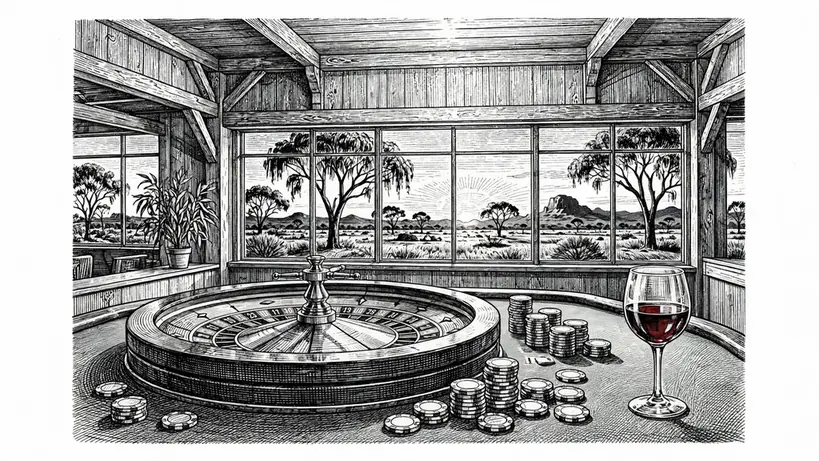
Land-based table games operate under a different framework. Australian casino venues are regulated by separate state or territory regulators, rather than by one national casino authority. That regulation applies to physical casino operations within the relevant jurisdiction. It does not create a domestic licence for online casino table games.
Consequently, a legal table game in a physical Australian casino and an online table game offered to an Australian customer are not equivalent products. The first belongs to the state or territory land-based regime. The second falls within the federal restrictions on prohibited interactive gambling services when supplied online to an Australian resident.
This is also why phrases such as “table games at casino” or “table games in casino” can describe two legally different settings. A physical venue may operate under local regulation, while an online platform may be offshore and outside Australian supervision. The game name alone does not determine the legal status of the service.
The rules may come from offshore sources
A profile gambling review states that offshore operators can choose the rule sets governing their online table games because no Australian regulator monitors them. That is a description of the regulatory gap, not a market-wide assurance about fairness or uniformity. The rules displayed by an offshore platform should not be treated as rules approved by an Australian authority.
The point matters because the table, settlement terms and operating conditions are controlled by the offshore service. Australian oversight does not validate the game, certify the operator or provide a domestic complaints route. Any decision to use an offshore real-money table game remains separate from the regulated Australian land-based casino system.
Legal Status Australian companies are prohibited from offering online casino services or online poker to Australian residents under the Interactive Gambling Act 2001.
For real-money casino table games in Australia in 2026, the legal baseline is therefore narrow: Australian companies cannot offer online casino services, including online poker, to Australian residents; no domestically licensed real-money online casino exists; and an individual is not prosecuted simply for playing at an offshore site. Offshore play remains outside Australian regulatory supervision and carries the player’s own risk.
The Table Games Found on Online Casino Platforms
Online casino platforms organise table games into a small number of recognisable formats. The core menu is built around blackjack, baccarat, roulette and poker, with live dealer tables adding streamed dealing, a named dealer and a visible table interface. Free-play versions may also appear, but availability depends on the platform and should not be treated as permanent.
Blackjack
Blackjack is a card game played against the dealer rather than against the other players at the table. The central objective is to finish with a hand closer to 21 than the dealer’s hand without going over. The menu may include standard blackjack alongside variants that alter the number of decks, available side bets or dealer rules.
The game’s format makes the available decisions important. A player may choose whether to hit, stand, split or double down, subject to the table rules. Basic strategy blackjack has a house edge below 0.5%, according to the supplied game-mathematics information. That figure describes a mathematical benchmark under the stated rules and strategy; it is not a promise attached to every blackjack table.
Live blackjack presents the same basic card structure through a dealer-led interface. A single-table stream can offer several betting positions, while the dealer handles the cards and announces the result. A profile review reports live blackjack limits from $1 AUD to $5,000 AUD per hand depending on table tier. That is a reported range from one source, not a universal market standard.

Baccarat
Baccarat uses player and banker designations, but those labels describe the two hands rather than the identity of the person placing the wager. The usual menu presents three principal outcomes: the player hand wins, the banker hand wins, or the hands tie. Cards are dealt according to fixed rules, so the game does not require the same sequence of playing decisions as blackjack.
Online baccarat may be offered in an automated format or through a live dealer table. The visual presentation can differ substantially: some tables show only digital cards and result panels, while live dealer tables display the dealer, physical cards and betting timer. The underlying category remains baccarat, even when the interface changes.
Roulette
Roulette is built around a numbered wheel, a ball and wagers on individual numbers or groups of numbers. Online menus can separate roulette by presentation, wheel design and dealer format. A digital table may use animation and an automated result, while a live dealer table shows the physical wheel and the dealer’s actions.
The betting layout generally includes both inside wagers, such as a number, and outside wagers, such as a colour or range. Those labels describe where the chip is placed on the layout; they do not turn the game into a skill-based table. Live roulette is also one of the formats specifically associated with Evolution in a profile review of live-dealer providers. The same review identifies roulette, blackjack, baccarat and game shows in that provider’s live-dealer catalogue.
Poker
Online casino menus use “poker” to cover more than one format. In a casino table-game context, the player may be competing with the house under fixed rules rather than joining a peer-to-peer poker room. The exact structure therefore matters: the table title should identify whether the game is a casino poker variant, a tournament format or a player-versus-player product.
A card game played against the dealer where the objective is to get closer to 21 without going over.
A game using player and banker designations where cards are dealt according to fixed rules.
A game built around a numbered wheel where wagers are placed on individual numbers or groups.
A format that may involve competing with the house or other participants depending on the specific variant.
Poker also differs from blackjack, baccarat and roulette because the player’s result may depend on the hand or position of other participants, depending on the variant. A platform’s lobby should be read by game name and rules rather than by the broad word “poker” alone. Australian companies are prohibited from offering online poker to Australian residents under the Interactive Gambling Act 2001; that legal point remains separate from the way platforms classify the game menu.
Live dealer tables
Live dealer tables combine a video stream with an online betting interface. The dealer manages the physical cards, wheel or other table equipment, while the platform displays the betting window, available positions and settlement information. Blackjack, baccarat and roulette are the principal examples identified in the supplied platform facts.
A profile review describes Evolution as the dominant live-dealer provider and lists roulette, blackjack, baccarat and game shows among its offerings. Because that statement comes from one profile review, it should be read as a source-specific market description rather than as an independently verified industry ranking.
A separate operator review states that Retro33 Casino includes live dealer blackjack and roulette. That observation applies to the reviewed operator’s listed menu only. It does not establish that every platform carries the same tables, nor does a named game menu establish Australian regulatory supervision.
Choosing by format rather than label
The same game can feel different across automated and live formats. Blackjack may be presented as a digital table or with a streamed dealer. Roulette may use animation or a physical wheel. Baccarat may display a simplified interface or a full live table. The relevant comparison is the actual game title, rules panel, table tier and interface.

For free-play use, the distinction is direct: a table that accepts no real-money stake is a practice or entertainment format, not a real-money wager. For real-money online casino services, Australian law prohibits companies from offering casino games to Australian residents, including online blackjack, roulette, baccarat and poker. Offshore platforms are not supervised by an Australian regulator, so their menus, rules and live-table descriptions cannot be treated as Australian-approved product listings.
Live Tables, Local Casinos and the “Near Me” Question
A search for a casino with table games nearby can refer to two different products: a physical casino in Australia or an offshore website showing live dealer tables. The distinction affects regulation, opening hours, access and financial risk. Distance is relevant to the first category; it does not turn the second into an Australian-licensed service.
Physical casinos and state-based regulation
Australian land-based casinos operate under separate state and territory regulatory systems. A casino in New South Wales is therefore not regulated through the same local framework as one in Victoria, Queensland, South Australia, Western Australia, Tasmania, the Australian Capital Territory or the Northern Territory. The relevant regulator depends on the venue’s location.
That structure matters when checking a nearby casino’s table-game offering. A venue may have blackjack, roulette, baccarat or poker tables, but the existence of a physical casino does not establish the legality of an online equivalent. Land-based gambling and online casino services are treated as separate products.
The practical checks for a local venue are therefore specific:
- whether the casino is physically open;
- whether its table-game floor is operating;
- which games are offered on that day;
- whether particular tables have restricted sessions;
- whether entry conditions or identification requirements apply;
- whether the venue’s state or territory regulator oversees its operations.
The available facts do not establish opening hours for any particular Australian casino. A question such as “what time do table games open at the casino?” cannot be answered with one national timetable. Casino building hours, gaming-floor hours and individual table availability may be different matters. The venue’s current official information is the appropriate source for those details.
A nearby casino also may not be the closest venue with the preferred game. A location search can identify proximity, but it does not prove that blackjack, roulette or baccarat is operating when the venue is visited. The financially relevant result is the combination of distance, opening status and available table rules—not the map pin alone.
What “near me” means in practice
“Casino near me with table games” and similar location-based wording normally describes a physical venue search. It can include casinos near a city centre, a regional town or an airport, but the useful answer depends on the state or territory. Australian casinos are not interchangeable national outlets with one uniform schedule.
Local vs Offshore Physical casinos in Australia are regulated by specific state or territory authorities, whereas offshore online platforms operate outside Australian regulatory supervision.
The same logic applies to searches for the closest casino to a major city. A casino near Sydney, Melbourne or another metropolitan area should be assessed as a local venue under the applicable state or territory framework. A search for casinos in another country, such as Ohio or near New York City, belongs to that jurisdiction and does not provide evidence about Australian availability. Likewise, a search mentioning Ho Chi Minh City concerns a Vietnamese location, not an Australian casino option.
Location also changes the meaning of “live.” At a physical casino, a live table means an in-person table staffed at the venue. The dealer, table, chips and betting activity are present on the gaming floor. On an offshore website, a live dealer table is a streamed online service. It may show a dealer operating roulette, blackjack or baccarat, but it remains an online casino service offered from outside Australia.
Offshore live dealer tables
Online platforms use live dealer rooms to present table games through video and digital betting interfaces. A profile review describes Evolution as the dominant live dealer provider, with roulette, blackjack, baccarat and game shows in its catalogue. That description identifies a provider and its reported product range; it does not establish Australian approval or supervision.
A separate profile review reports live blackjack limits from $1 AUD to $5,000 AUD per hand, depending on the table tier. Those figures belong to the reviewed online offering and should not be treated as a universal Australian market range. Table limits are platform-specific, and an offshore operator can present a different structure.
Retro33 Casino is reported in an operator review as offering live dealer blackjack and roulette, with deposits displayed in Australian dollars. The same review reports a minimum age of 18 and lists deposit limits, session reminders and cooling-off periods. These are claims about that operator’s stated arrangements, not evidence of an Australian casino licence.
The regulatory position remains unchanged regardless of the game, currency display or streaming quality. No domestically licensed real-money online casino exists for Australian players. Offshore live dealer tables are not supervised by an Australian regulator, and participation takes place at the player’s own risk. An Australian-dollar balance is a payment display choice, not an Australian licence.
Regulatory Summary Offshore play remains outside Australian regulatory supervision and carries the player’s own risk.
Comparing a local table with an online live table
A physical venue and an offshore live dealer room should be compared by category rather than placed in one list of “best” tables.
| Point of comparison | Physical Australian casino | Offshore online live table |
|---|---|---|
| Location | A venue in a particular state or territory | A remote online service |
| Regulatory framework | State or territory casino regulation | Not supervised by an Australian regulator |
| Opening question | Depends on the venue and its gaming-floor schedule | Depends on the platform’s published availability |
| Table access | Requires reaching the venue | Available remotely where the offshore service accepts the player |
| Legal position | Land-based casino gambling is regulated locally | Online casino services cannot be provided to Australian residents by Australian companies |
| Financial risk | Includes travel and in-venue spending | Includes the risk of dealing with an offshore operator |
The phrase “best online live casino table games” therefore cannot be treated as a recommendation of a licensed Australian product. It may describe a comparison of game presentation, table limits or available formats, but offshore availability does not create domestic regulatory protection.
The same caution applies to no-deposit offers attached to table games. A bonus label does not change the service’s legal status, and the supplied facts do not establish any particular promotion, wagering condition or withdrawal term. The relevant distinction is simple: a physical Australian casino operates within state or territory regulation; an offshore live dealer site does not operate on an Australian-licensed footing.
Which Table Games Offer the Strongest Mathematical Position?
The strongest mathematical position at a casino table comes from the combination of a low house edge, a transparent RTP (Return to Player) figure and decisions that can be controlled rather than guessed. Promotional value does not change the underlying probability. A bonus may alter the amount required before withdrawal, while the table’s mathematics remains the same.
For Australian readers, this distinction has an additional legal consequence. Online casino games offered to Australian customers are prohibited interactive gambling services under the Interactive Gambling Act 2001. No domestically licensed real-money online casino exists for Australian players. Offshore play is not supervised by an Australian regulator and remains the player’s own risk. The calculations below describe game mathematics, not a recommendation to use an offshore service.

House edge comes first
House edge is the casino’s mathematical advantage over a large number of wagers. A lower figure is better for the player; a higher figure is worse. RTP expresses the same relationship from the player’s side: a higher RTP indicates a larger theoretical return over a long sequence of bets.
Neither measure predicts the result of a single hand or spin. A game can have an attractive RTP and still produce a losing session. The figure is a long-run calculation, not a promise of a particular outcome or withdrawal.
A benchmark cited by the Australian Gambling Research Centre is to choose games with RTP above 96%. That is a benchmark from an industry body, not a guarantee attached to every table or every session. A separate profile review reports that the platforms it examined averaged 97.1% RTP, but that figure describes the reviewed sample rather than the entire online casino market.
The table rules still matter. An offshore operator can select the rules governing an online table because no Australian regulator monitors those services, according to a profile review. Two games carrying the same name can therefore have different mathematical conditions. A comparison is incomplete if it lists only the game title and ignores the stated RTP, rule set or table variant.
Why blackjack is often the leading candidate
Blackjack gives the player decisions that affect the expected result. Card value, the dealer’s exposed card and the table rules determine whether the mathematically stronger action is to hit, stand, double or split. Basic strategy converts those variables into a defined decision process instead of relying on instinct.
Blackjack House Edge Basic strategy blackjack has a house edge below 0.5% according to mathematical benchmarks.
With basic strategy, blackjack has a house edge below 0.5%. That makes it the clearest example of a table game where skill in decision selection can materially improve the mathematical position. The result depends on the exact rules and on following the strategy consistently; the figure should not be transferred automatically to every blackjack table.
A player who ignores basic strategy is not merely changing style. Each avoidable decision can move the expected result away from the stated benchmark. The practical comparison is therefore between the rules of the table and the quality of the decision process, not between promotional labels such as “premium” or “elite.”
Comparing other table-game positions
RTP is the more useful starting point when comparing games whose decisions cannot be improved in the same way. Roulette, baccarat and some poker-style table formats can differ by variant and rule set. The available facts do not establish one universal house edge for every version, so a fixed ranking would create false precision.
The workable selection framework is narrow:
- identify the exact table variant;
- locate the published RTP (Return to Player);
- check whether the rules differ between standard and live dealer formats;
- reject a comparison that gives no mathematical figure;
- treat a higher RTP as a stronger theoretical position, not as a session guarantee.
This also answers the question of which table games have the best odds without confusing categories. A game with a higher stated RTP is mathematically preferable to one with a lower stated RTP, provided the figures are calculated on a comparable basis. The name of the game alone is not enough.
Promotions do not improve the table
The phrase “best casino promotions for table games” concerns conditions outside the game’s base mathematics. Bonus wagering rules can restrict which tables count and how much each wager contributes. A profile review states that live casino wagering contribution may be limited to 10% or excluded entirely from bonus wagering. That condition must be read before treating a bonus as part of the calculation.
Other terms can determine the actual value: wagering requirements, withdrawal limits, game restrictions, expiry periods and maximum bets. A large advertised balance has no reliable value if the table contributes little or nothing toward the required wagering. The correct comparison is between the cash cost of the required play and the amount that can actually be withdrawn, not the headline bonus.

Bitcoin or another payment method does not alter the house edge either. It changes transaction mechanics, not the probability of a blackjack hand, roulette outcome or baccarat result. The same principle applies to poker-style table games: a payment label cannot turn a weaker mathematical position into a stronger one.
The worst odds are found by the same method. A table with a lower RTP, a higher stated house edge or restrictive rules is mathematically less favourable than a comparable table with better published conditions. Where no RTP or house-edge figure is displayed, the result cannot be verified. That lack of information is itself a reason not to treat the table as a sound comparison candidate.
Dealer Pay and the Systems Behind Casino Tables
Searches about casino table-game dealers and casino management software describe two different industries. One concerns employment. The other concerns business operations. Neither should be treated as a guide to selecting table games or assessing an online casino.
Dealer salary is an employment question
The supplied market information does not establish a salary, hourly rate, commission structure, or benefits package for casino table-game dealers in Australia. A precise figure would therefore be unsupported. Pay can depend on the employer, state or territory, venue, roster, experience, and employment arrangement, but those variables do not produce a verified amount here.
Management Software Systems used by casino operators to support the administration of tables, staff, records, and venue controls.
The legal setting also matters. Australian land-based casino table games are regulated by separate state and territory regulators. Working as a dealer at a physical casino is therefore connected with a regulated venue and its employment requirements. That should not be confused with providing online casino services to Australian residents, which companies are prohibited from doing under the Interactive Gambling Act 2001.
A dealer’s salary has no direct relationship with a table’s RTP, house edge, betting limits, or the suitability of a game for a player. It is a labour-market issue, not a mathematical property of blackjack, baccarat, roulette, or poker.
Management software serves the operator
Casino table-game management software belongs to the operational side of a casino. It can support the administration of tables, staff, records, controls, and other venue processes. The available facts do not identify a specific software product, supplier, feature set, price, or performance standard, so none of those details can be stated as established.
This type of system is purchased or assessed by casino operators and managers. It is not a player-facing table-game feature and does not determine whether a game offers a favourable RTP or a lower house edge. A software platform also does not create an Australian licence for online casino services, and it does not place an offshore operator under Australian regulatory supervision.
The distinction is financially important: dealer pay belongs to employment research, while management software belongs to B2B procurement. Neither answers the player’s question of which table game has the strongest mathematical position.
House Edge: Reading a Table-Game Comparison
A casino table-games house-edge chart should be read as a mathematical comparison, not as a promise of results. The house edge is the theoretical advantage retained by the casino over a large number of bets under stated rules. It does not predict the outcome of a particular session, and it does not remove the effect of table rules, betting decisions or errors.
The first check is whether every figure uses the same basis. A chart may compare house edge, RTP (Return to Player), or both. These measures describe opposite sides of the same calculation: a lower house edge corresponds to a higher RTP. A stated RTP above 96% aligns with a recommendation attributed to an industry-body source, but that benchmark does not prove that every table, rule set or offshore platform reaches it.
The second check is the rule set. A blackjack figure has little meaning without the relevant rules and strategy assumptions. Basic-strategy blackjack has a house edge below 0.5%, but that result depends on applying the specified strategy rather than making decisions at random. A chart that omits the strategy basis is incomplete, even when its percentage appears precise.
A useful comparison should therefore show:
- the game and variant;
- the house-edge or RTP measure;
- the rules or assumptions behind the figure;
- whether the number is theoretical rather than a session guarantee.
Promotional language belongs in a separate column, if it appears at all. Claims such as “best odds” or “low edge” are not mathematical evidence unless the underlying figure and conditions are stated. Bonus terms also do not improve the underlying table mathematics; they introduce separate conditions that must be assessed independently.
For offshore online tables, the displayed figure remains a claim about the selected game and rules, not proof of Australian supervision. Offshore play is not monitored by an Australian regulator, so a comparison chart cannot turn an unlicensed service into an Australian-regulated one. The cleanest reading is narrow: compare disclosed mathematics, verify the assumptions, and treat every unstated condition as unresolved.
Free Table-Game Demos Without a Download
Browser-based demo tables provide a way to examine game mechanics without installing software or placing a real-money stake. The available formats can include blackjack, baccarat, roulette, poker, and selected live dealer games, depending on the platform and its current catalogue. In a demo, the balance is not cash and cannot be withdrawn; the result is practice, not gambling for a financial return.
- Use demo versions for entertainment
- Examine game mechanics without stakes
- Use offshore sites at your own risk
- Accept that online services lack Australian supervision
The legal distinction is material. Free-play table games that accept no real-money stake are described as outside the prohibition in the Interactive Gambling Act 2001. That does not convert a real-money online casino service into a permitted Australian product. The dividing condition is the absence of a real-money stake. Once deposits, cash wagers or withdrawals enter the transaction, the activity belongs to a different legal category.
What “Without a Download” Means
A no-download demo runs in a web browser rather than through a desktop or mobile installation. The practical advantage is limited to access: the game can load on a compatible device without an installation step. It does not establish that the platform is Australian-licensed, and it does not provide the regulatory protections associated with a domestic licence. No domestically licensed real-money online casino exists for Australian players.
Demo presentation also varies. Some tables reproduce the visual layout and dealing sequence of a cash game; others simplify the interface or use an automatically replenished practice balance. Those details affect usability, not legal status. A familiar interface is still only a simulation when no real-money stake is accepted.
Availability must be treated as conditional. A platform may remove a demo, restrict access by location, replace a game, or require registration before loading the table. No permanent or guaranteed catalogue can be inferred from a page that is visible at one point in time. The sensible accounting treatment is therefore straightforward: a free demo has entertainment or practice value, but no cash value and no basis for assuming that the related real-money service is lawful in Australia.

Bitcoin Table Games Compared with Conventional Casino Tables
The difference between Bitcoin table games and conventional casino tables is primarily transactional, not mathematical. Blackjack, roulette and baccarat do not become different games because the deposit or withdrawal method changes. The relevant comparison is the movement of funds: processing time, possible charges, exchange-rate exposure and the level of payment information required.
Bitcoin withdrawals
A profile review reports that crypto withdrawals can be completed in 30 minutes to 2 hours at fast-payout platforms. That is a stated performance range for the platforms covered by that review, not a market-wide service standard. Blockchain confirmation, internal approval and account verification can still affect the final result.
KYC remains a separate condition. Registration guidance requires verification before a first withdrawal, with documents such as a driver’s licence, passport or proof of address. Bitcoin therefore does not remove the identity-check stage; it changes the payment rail used after approval.
Crypto also introduces costs that are not visible in the table interface. The transaction may involve network fees, conversion costs or changes in the value of the currency before the withdrawal is received. A nominally fast transfer can therefore produce a different net amount from the figure requested.
Conventional payment methods
Card deposits may be treated as cash advances by banks, which can result in charges, according to a payment-method review. The final cost depends on the bank and the card terms, so the displayed deposit amount is not necessarily the full transaction cost.
Bank transfers, cards, e-wallets and prepaid vouchers each create different operational conditions. The payment method can affect approval, fees and withdrawal compatibility, while the game’s rules remain unchanged. A method that accepts deposits may not be available for withdrawals, and a rapid deposit does not establish rapid access to funds.
Payment Risks Attention Using Bitcoin or conventional cards does not change the legal status of offshore services or provide Australian regulatory protection.
None of these routes changes the legal position. Offshore online casino play is not supervised by an Australian regulator, and payment through Bitcoin or conventional channels does not create an Australian casino licence. The comparison is therefore a risk-and-cost assessment, not evidence that either route is an Australian-regulated option.
Pai Gow Poker: Where It Fits Among Table Games
Pai Gow Poker is a distinct casino table-game format, not another name for blackjack, baccarat or roulette. Its identity comes from the poker-based structure of the hand and the way the player’s cards are arranged. That makes it relevant to searches for poker table games while still placing it within the wider casino-table category.
A standard online table menu may place Pai Gow Poker alongside blackjack, baccarat, roulette and poker variants. The presence of the title does not establish identical rules across platforms. According to a specialist gambling review, offshore operators can determine the rule sets used for online tables because no Australian regulator supervises those services. The practical consequence is that the table name alone is not enough to establish how the game is dealt, how hands are ranked or how a house hand is settled.
What separates Pai Gow Poker
Pai Gow Poker should be assessed as its own format for three reasons:
- It is poker-based rather than a blackjack total game.
- It is not a roulette game built around numbered or coloured outcomes.
- It has a different decision structure from baccarat, where the player generally selects a betting position rather than arranging a poker hand.
Those differences matter when comparing a casino table menu. A platform listing Pai Gow Poker is offering a separate ruleset and not merely a visual variation of a better-known table. Any comparison should therefore use the specific game rules and displayed return information for that table, rather than transferring assumptions from blackjack or roulette.
For Australian players, online availability offshore does not change the legal position. Australian companies cannot provide online casino services to Australian residents, and no domestically licensed real-money online casino exists for this market. Playing at an offshore site is not supervised by an Australian regulator and remains the player’s own risk. The game’s title, poker format or presentation as a live dealer table does not create Australian regulatory approval. Thus, Pai Gow Poker belongs in the catalogue of named casino table formats, but its offshore availability must not be confused with a licensed Australian service.
How Canadian Table-Game Casinos Differ from the Australian Position
Canada-specific table-game information needs to be separated from the Australian legal position. The fact that a platform describes its blackjack, roulette, baccarat or poker selection as Canadian does not establish permission to provide those games to Australian residents. Jurisdiction is not a label attached to the game interface; it determines which authority, if any, supervises the service.
Australia uses a divided regulatory structure for land-based gambling. Casino table games at physical venues are regulated by the relevant state or territory authority, so the applicable rules depend on where the casino operates. That framework does not create a domestic licence for real-money online casino games. Australian companies remain prohibited from offering online casino services, including online poker, to Australian residents under the Interactive Gambling Act 2001.
A Canadian-facing table-game site may therefore be relevant to a jurisdiction comparison without being an Australian-licensed option. No individual Canadian casino is assessed here, and no overseas operator should be treated as approved by the Australian Communications and Media Authority. The ACMA can investigate illegal offshore gambling services and request website blocking, but it does not supervise offshore casino tables as an Australian regulator.
The key difference is regulatory context, not the names of the games. An offshore service can select the rule sets used for its online tables because no Australian regulator monitors those rules. This point comes from a specialist industry overview, not from an Australian licensing decision. Stated limits, game rules, settlement procedures and dispute routes therefore require separate verification, and none should be inferred from the word “Canada”.
Australian residents are not committing a crime merely by playing at an offshore casino, but the service remains outside Australian casino licensing. Any participation is at the player’s own risk, without supervision by an Australian regulator. That is the material distinction between Canadian table-game references and the Australian position: overseas presentation does not convert prohibited online casino supply into a locally licensed product.
Are real online casino Australia platforms safe to use?
No Australian regulator supervises offshore online casino platforms, and they do not operate under an Australian casino licence. Players are not prosecuted merely for playing, but they assume the risk and have limited legal recourse if an account, balance or payout dispute occurs.
What payment methods work at real online casino Australia sites?
Common options include cards, e-wallets, bank transfers, prepaid vouchers and cryptocurrency. E-wallets and cryptocurrency are generally faster, while bank transfers usually cost less but take longer; cards may be treated as cash advances, and prepaid vouchers can make withdrawals more difficult.
What are the emerging risks in online gambling?
Key risks include using offshore operators without Australian regulatory supervision, blocked websites, limited remedies over accounts or payouts, and unclear game rules or settlement terms. Players may also face payment fees and withdrawal difficulties.
How are complaints about online gambling handled?
Complaints to an offshore casino are handled by the operator, with no Australian regulator providing a domestic complaints route for the service. ACMA can investigate illegal offshore gambling sites and request that internet service providers block them, but this does not guarantee resolution of an individual account or payout dispute.
Prepared by the Australia Betting Info editorial staff.