
Best RTP Pokies in Australia: How RTP Works
 Available in AU
Understand theoretical returns, game design and the limits of comparing payout percentages across Australian pokies.

Table of Contents
- RTP Explained: What the Percentage Actually Measures
- High-RTP Pokies in Australia: The Payout Figure Is Not the Whole Price
- High-RTP Online Pokies: Reading the Game Before the Spin
- The Highest-RTP Pokies: What Can Be Compared, and What Cannot
- Best RTP Online Pokies for Australian Players: The Legal Access Problem
- Pokies with the Highest RTP: A Ranking Without a Guarantee
- Australian Pokies RTP: Terminology, Regulation and Player Options
- RTP and the Best Payout: Why the Biggest Win Is Not the Best Return
RTP Explained: What the Percentage Actually Measures
RTP means Return to Player. It is the theoretical proportion of wagered money that a pokie returns over a very large number of spins. The percentage describes the mathematical design of the game, not the result of a particular visit, deposit, or session.
A game with an RTP of 96%, for example, is designed to return A$96 for every A$100 wagered in the long-run theoretical model. The remaining A$4 represents the mathematical house edge. This is not a forecast for one punter’s balance. It is an aggregate expectation that becomes meaningful only across an extremely large sample of independent outcomes.
That distinction controls how RTP pokies should be read. The figure is a statistical property of the game, not a promise attached to a spin button.
RTP is not a session result
A pokie does not calculate a player’s personal return and then adjust each outcome to match the advertised percentage. Each spin is independent. The result of the previous spin has no bearing on the next one, whether the previous outcome was a win, a loss, or a large payout.
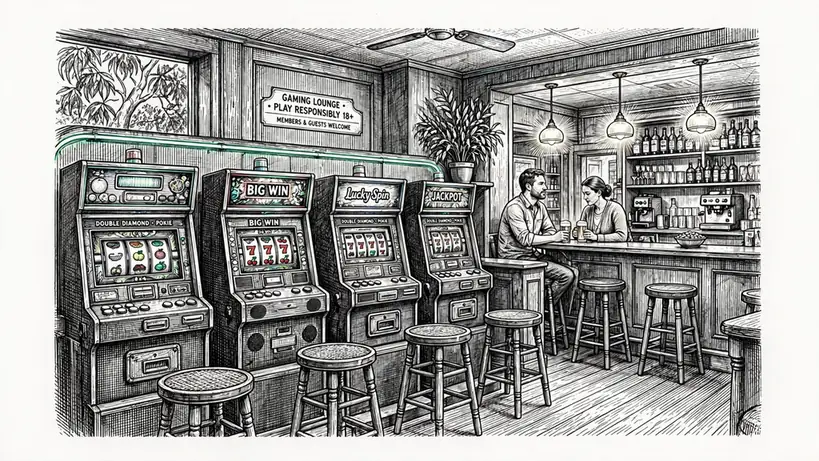
This means a short session can finish well above the theoretical return, well below it, or with no meaningful relationship to it at all. A player may receive several winning combinations in succession, or may experience a long sequence without a significant return. Neither outcome proves that the game has changed its RTP.
The same principle applies after a substantial win. The machine does not “owe” a losing spin because a jackpot or feature has just appeared. Equally, a run of losses does not make a win more likely on the next attempt. Independence leaves no balance to correct.
RTP therefore cannot answer questions such as:
- how much a particular session will return;
- when the next winning combination will appear;
- whether losses will be recovered;
- whether a recent win makes the next spin less favourable;
- whether a long losing run means a payout is due.
Those are session-level questions. RTP is a long-term mathematical measure.
What “long term” means
The long-term nature of RTP is more important than the percentage itself. The theoretical return emerges from a large population of spins, not from a convenient personal sample. Short sequences contain too much random variation for the stated figure to function as a reliable individual result.
Suppose a pokie has a theoretical RTP of 95%. That does not mean every set of one hundred spins will return 95% of the amount wagered. It does not mean a fixed amount will come back after a fixed number of spins. The result can differ materially because the game’s outcomes are random and independent.
The percentage is best understood as an expected average across repeated play under the game’s mathematical rules. It describes the destination of a very large statistical process, not the route taken by any one session.
This also explains why two separate players can have sharply different results on the same game at the same time. One may hit a feature early; another may not. Their outcomes do not cancel each other within either individual account. The advertised RTP belongs to the game model, while the actual return belongs to the particular sequence of spins.


Reading the percentage correctly
RTP is expressed as a percentage because it compares theoretical returns with total stakes. It is not a percentage chance of winning on every spin, and it is not the probability that a session will end in profit.
A 97% RTP does not mean that 97 out of 100 spins win. It does not mean that 97% of punters receive money back. A small number of large payouts can contribute substantially to the theoretical return, while many other spins may produce no return or a modest one.
The figure also does not describe the timing of payouts. RTP says how the game is expected to distribute value over the long run. It does not say whether returns arrive steadily, appear in occasional large combinations, or remain absent during a particular stretch. Those characteristics belong to other parts of the game’s mathematical profile and should not be inferred from RTP alone.
For the same reason, the highest listed RTP is not automatically a prediction of the highest personal result. It is one comparable design statistic. Actual outcomes still depend on the independent sequence generated during the session.
RTP Definition Theoretical proportion of wagered money returned over a large number of spins
Mathematical Nature A statistical property of the game model, not a session forecast
Key Variables RTP, Volatility, and Stake Size
Online pokies use the same core measure
In Australian usage, “pokies” is the established term for gaming machines. International casino material often uses “slots” or “slot machines” for the same basic product. When the game is presented online, the terminology changes more readily than the underlying mathematics.
Online pokies and land-based slot machines use reels, RTP, and volatility as core features of their game design. RTP retains the same meaning in both formats: a long-term theoretical average rather than an individual outcome. Moving the game from a venue cabinet to an online interface does not turn the percentage into a personal repayment schedule.
The display may show reels spinning digitally instead of mechanically, but that visual difference does not alter the interpretation of the figure. A result remains an independent outcome, and the previous result remains irrelevant to the next one.
The practical meaning of RTP pokies
The phrase “RTP pokies” refers to games assessed by this theoretical return measure. “Pokies RTP Australia” and “RTP pokies Australia” describe the same analytical question in local terms: what return percentage is assigned to a particular pokie, and what does that percentage actually tell the punter?
It tells the expected long-run relationship between stakes and returns under the game’s rules. It does not establish a guaranteed payout, a minimum session return, or a timetable for winning combinations.
That is the correct starting point for comparing the best RTP pokies Australia may feature in 2026. Before any game is labelled better on the basis of its percentage, the figure must be kept in its proper category: a theoretical average across independent spins, not a contract for the next result.

High-RTP Pokies in Australia: The Payout Figure Is Not the Whole Price
A high RTP is useful, but it is not a complete description of a pokie’s financial behaviour. The figure describes the theoretical share returned over a very long sequence of spins. It does not show how frequently wins appear, how large those wins tend to be, or how uneven the path between deposits and payouts can feel. Those features are associated with volatility.
For a money-focused comparison, RTP and volatility need to be read together. RTP addresses the long-term return rate. Volatility describes the distribution of results around that rate. Two pokies can therefore have a similarly attractive RTP while producing very different playing experiences and very different short-term cash-flow patterns.
RTP and volatility measure different things
High-variance pokies pay out less frequently but in larger amounts. Low-variance pokies pay out more often in smaller amounts. Neither description changes the RTP by itself. It changes the route through which results are distributed.
A high-variance game can produce a long sequence without a meaningful return, followed by a comparatively large payout. A low-variance game may produce more regular winning events, but those wins are smaller and may not offset the accumulated stake. Frequency is not the same as profitability. A winning spin still has to be assessed against the amount wagered across the surrounding spins.
This is the first price of choosing a high-RTP pokie: the displayed return may look favourable in isolation, while the volatility determines how much capital is exposed before that theoretical return has any practical chance to appear. A high RTP does not convert a high-variance game into a steady-income product.
- Use RTP to understand long-term mathematical design
- Check volatility to understand result distribution
- Verify stake size relative to your bankroll
- Treat RTP as a guaranteed payout for a session
- Assume a win is “due” after a losing streak
- Expect high RTP to offset high volatility
Why the largest payout can be expensive
Large advertised wins attract attention because they create a visible upside. They do not reveal the number or value of losing spins required before such a result occurs. In a high-variance pokie, the largest outcomes may account for a substantial part of the game’s long-term return. The remaining results can be much less generous.
That structure creates a difference between expected return and usable bankroll. A player may not have enough funds, time, or tolerance to remain in the game through the sequence needed for the long-term mathematics to become relevant. The theoretical percentage remains unchanged, but the practical result is determined by the session’s stopping point.
Low-variance games change the pattern rather than removing the cost. More frequent payouts can make the balance move less sharply, yet small wins may return only a limited part of the stake. A series of modest prizes can therefore look active without producing a positive net result. Frequent wins are not evidence of a better RTP, and infrequent wins are not evidence of a worse one.
Stake size changes the exposure
Most online pokies allow bets ranging from a few cents to hundreds of dollars per spin. The available range does not make every stake financially equivalent. A percentage-based return applies to the amount wagered, so the cash value of both losses and theoretical returns expands as the stake increases.

The same volatility profile becomes materially more demanding when each spin carries a larger amount. A high-variance pokie played at a substantial stake can consume funds through losing sequences faster than the same game played at a smaller stake. RTP has not changed; the exposure per outcome has.
This is why a high RTP should not be treated as a reason to select the maximum available bet. Bet size changes the amount at risk on every independent spin, while the previous result has no bearing on the next outcome. Increasing the stake after losses does not improve the game’s underlying return or compensate for an earlier result.
Reading a high-RTP pokie as a financial product
The practical comparison should separate three questions:
- What is the stated RTP? This indicates the long-term theoretical return.
- How is the return distributed? Volatility indicates whether payouts tend to be less frequent and larger or more frequent and smaller.
- What stake is being exposed on each spin? The permitted betting range determines how quickly the same mathematical profile can translate into actual money gained or lost.
Only the first question concerns the headline payout figure. The second explains the shape of the results, and the third determines their cash impact. Omitting either of them turns a financial comparison into a percentage comparison.
The phrase “best high-RTP pokies” is therefore incomplete unless “best” has a defined financial meaning. A game with a high theoretical return and high volatility may suit a punter seeking occasional large outcomes, but it carries a less regular payout pattern. A lower-volatility game may produce more frequent smaller wins, yet that does not establish a superior overall return. The relevant distinction is not which pattern sounds better; it is which distribution matches the available stake and the amount of short-term loss that can be absorbed.
In Australia, the word “pokies” covers the same basic mechanics that are described elsewhere as online slots: reels, RTP and volatility remain the relevant measures. The terminology does not alter the mathematics. A high RTP remains one component of the price, while volatility and stake size determine how that price is experienced in actual play.
Checking Game Mechanics
- Verify the stated RTP in the game information panel
- Identify the volatility level (high vs low variance)
- Confirm the provider (e.g., Pragmatic Play, NetEnt)
- Check the minimum and maximum permitted stakes
High-RTP Online Pokies: Reading the Game Before the Spin
Online pokies are not a separate mathematical species. The screen may replace a cabinet, buttons may become touch controls, and the terminology may shift between Australian and international markets, but the underlying structure remains familiar. The reels, RTP and volatility work in the same way as they do on a physical slot machine. The difference is the format in which the game is delivered and the language used to describe it.
That distinction matters when assessing high-RTP online pokies. A game does not become better value merely because it is displayed in a browser or mobile app. Its financial profile still depends on the stated RTP, the volatility setting, the paytable and the conditions attached to the game. The online presentation is not an alternative to those mechanics; it is only the delivery channel.
What to check on the game screen
The first useful document is the game information panel, not the promotional headline. Online pokies generally provide a help, information or paytable menu containing the rules, symbols, bonus features, RTP information and sometimes the volatility classification. The exact layout varies between providers, but the relevant details should be available before a spin is made.
RTP indicates the game’s long-term theoretical return. It is not a forecast for the next round, the current session or a particular deposit. A high stated percentage can be relevant when comparing games, but it does not alter the independence of each spin. A losing sequence does not make the next outcome more likely to win, and a recent prize does not reduce the mathematical possibility of another result.

Volatility supplies the second part of the assessment. It describes the distribution of results rather than replacing RTP. Higher-volatility pokies tend to produce less frequent wins with larger potential amounts, while lower-volatility games tend to produce more frequent wins of smaller size. Two online pokies can therefore show similar RTP figures while creating very different session patterns.
This is why the phrase “high RTP” is incomplete as a selection method. The percentage describes the theoretical return across a large number of plays. Volatility indicates how unevenly that return may be distributed. A game with a strong theoretical figure can still produce long intervals without a meaningful payout if its volatility is high. The accounting result of a short session may have little visible connection to the advertised percentage.
Online terms and physical mechanics
Australian usage generally favours “pokies”, while international game menus and software interfaces may use “slots” or “slot machines”. These labels do not identify different mechanics. The same reel arrangement, paylines, symbols, bonus rounds and random outcome system can appear in either format.
The online version may offer adjustable bet controls, autoplay functions, game history or a mobile interface. Those features change how quickly or conveniently spins can be made, not the mathematical identity of the game. They also do not change the fact that each spin is independent. A menu showing previous outcomes is a record, not a prediction tool.
Legal Restriction Real-money online pokies are prohibited for Australian residents under the Interactive Gambling Act 2001.
The provider name is another useful piece of information. Games from NetEnt, Pragmatic Play, Aristocrat, Microgaming, Play’n GO or Big Time Gaming may use different visual designs and feature structures, but the provider label alone says nothing about whether a particular title has high RTP or high volatility. Those characteristics belong to the individual game and its configuration.
A familiar title should therefore be assessed from its current information panel rather than from its reputation. Gates of Olympus, Big Bass Bonanza, Book of Dead, Gonzo’s Quest, Money Train 4, Starburst and Sweet Bonanza are identifiable online pokies, but a name does not establish a return percentage, a volatility level or a legal status. Those details must be confirmed from the game’s own rules and the platform’s terms.
Randomness and platform controls
Licensed Australian-facing platforms are required to use independently audited random number generators. The RNG determines the outcome of each spin; it does not follow a pattern created by the previous result. A platform’s interface may display animation, celebrations or near-miss graphics, but presentation does not change the underlying random process.
The practical review should separate three questions:
- What does the game disclose? The paytable and information panel should state the relevant rules and RTP where that information is provided.
- How does the game distribute results? Volatility gives context to the expected frequency and size of payouts.
- What does the platform permit? Bet controls, account conditions and game restrictions belong to the platform, not to the reel mathematics.
This separation prevents a common accounting error: treating interface quality as evidence of better odds. Clear menus and smooth mobile performance may improve usability, but neither increases RTP nor reduces volatility. Likewise, a large advertised feature does not prove that the base game offers the strongest theoretical return.
A practical reading order
The most defensible order is simple: identify the exact title, open its rules, record the stated RTP, note the volatility description, then read the platform conditions separately. The result is a game assessment rather than a slogan.
“Pokies with high RTP” describes one measurable characteristic only. It does not establish frequent wins, a large individual payout or a profitable session. Online delivery adds convenience and additional interface information, but it leaves the essential mathematics unchanged.
The Highest-RTP Pokies: What Can Be Compared, and What Cannot
Ranking the highest-RTP pokies sounds precise, but the comparison has a narrow meaning. RTP describes a long-term theoretical average, not the result of a particular session. A title placed higher in an RTP table therefore has a stronger mathematical return assumption over a sufficiently large number of spins. It does not become more likely to produce a profit in the next spin, the next hour, or the next sequence of play.
That distinction matters when comparing named games. The available list includes:
- Gates of Olympus
- Big Bass Bonanza
- Book of Dead
- Gonzo’s Quest
- Money Train 4
- Starburst
- Sweet Bonanza
- 5 Dragons
- Buffalo
- Buffalo King Megaways
- Fire Joker
- Mega Joker
- Wolf Gold
- Aviator
- Blood Suckers
- Dead or Alive 2
- Devil’s Delight
- Dolphin Treasure
- Galactic Gold
- HollyWin
- Jackpot King
- JetX
- Mega Moolah
- Queen of the Nile
This is a catalogue of titles, not an RTP ranking. No verified RTP figures are available here for these games, so assigning an order would manufacture precision. A game cannot be labelled the highest-RTP pokie merely because it is familiar, widely advertised, or associated with a large jackpot. The percentage has to be stated by the relevant game information and interpreted as a theoretical return.
What an RTP comparison can establish
When reliable RTP figures are available for two pokies, the higher figure indicates the higher long-term theoretical return under the stated game conditions. That is the useful part of the comparison. It provides a mathematical basis for distinguishing one title from another instead of relying on themes, popularity, or the size of a headline prize.
The comparison still does not predict the distribution of individual outcomes. Each spin is independent, and the previous result has no bearing on the next one. A long sequence without a notable win does not make a payout due, while a recent large win does not improve the probability of another. The machine has no memory of the session; the accounting does.
Summary of RTP
- RTP is a long-term theoretical average, not a session prediction.
- High volatility can cause long losing streaks despite a high RTP.
- Each spin is an independent event unaffected by previous outcomes.
- Legal access in Australia is governed by the IGA, regardless of game mathematics.
RTP also cannot be separated from the way a game distributes its returns. High-variance pokies tend to pay less frequently but in larger amounts. Low-variance pokies tend to pay more often in smaller amounts. Two games could therefore present different playing experiences even if their theoretical returns were similar. Conversely, a game with a higher RTP could still produce a less suitable short session if its variance creates long gaps between payouts.
What the highest figure cannot prove
The highest RTP does not prove that a pokie is the most profitable choice for an individual session. It does not establish a guaranteed win, a minimum payout frequency, or a particular jackpot outcome. Nor does it show that the largest advertised prize is easier to reach. RTP concerns the aggregate mathematical return; it does not convert an uncertain result into a scheduled payment.
For Australian comparisons, the phrase “highest-RTP pokies Australia” should therefore be read as a description of game mathematics, not as a promise about a local session. A responsible ranking would show the verified RTP for each named title, identify the relevant volatility profile where available, and keep those measures separate. Without the underlying percentages, the defensible conclusion is limited: these games can be compared by RTP only when their published theoretical returns are known. Any stronger ranking would be decoration placed on missing data.
Best RTP Online Pokies for Australian Players: The Legal Access Problem
This selection brings together casinos worth reviewing when looking for high-RTP pokies in Australia in 2026. Use the available licensing, bonus, deposit, and payout details to identify which profiles best match your priorities.
License: Curacao eGaming OGL/2024/923/0383 (Antillephone N.V.) · Bonus: up to A$2,000 + 100 free spins across 2 deposits · Min. deposit: A$30 WinSpirit Casino operates under a Curacao eGaming licence issued to Antillephone N.V. Its welcome offer provides up to A$2,000 and 100 free spins across two deposits, with a A$30 minimum deposit.
License: Curacao eGaming (Roby Games Ltd) · Bonus: 100% up to A$750 + 200 free spins Roby Casino is licensed by Curacao eGaming through Roby Games Ltd. New players can claim a 100% bonus up to A$750 plus 200 free spins.
License: Curacao eGaming Licence · Min. deposit: A$10 PlayCroco holds a Curacao eGaming licence and supports entry with a A$10 minimum deposit. It is a straightforward option for players who prioritise a lower starting deposit.
License: Curacao eGaming Licence · Min. deposit: A$10 Fair Go Casino operates under a Curacao eGaming licence. Its A$10 minimum deposit makes it accessible to players who want to begin with a modest amount.
Bonus: 100% up to A$750 + 200 free spins, 35x wagering · Payout speed: crypto 30-120 minutes, fiat 24-72 hours · Min. deposit: A$30 MrPacho offers a 100% bonus up to A$750 with 200 free spins and 35x wagering. Crypto payouts are listed at 30–120 minutes, while fiat payouts take 24–72 hours; the minimum deposit is A$30.
License: Curacao · Bonus: up to A$10,000 multi-stage + 500 free spins · Min. deposit: A$20 (POLi) Lucky Dreams operates under a Curacao licence and features a multi-stage bonus of up to A$10,000 with 500 free spins. The minimum deposit is A$20 when using POLi.
License: Curacao eGaming (Hollycorn N.V., since 2017) · Bonus: 225% up to A$1,540 + 600 free spins across 4 deposits, 20x wagering · Min. deposit: A$20-30 (depends on the offer) Playfina Casino has operated under Curacao eGaming through Hollycorn N.V. since 2017. Its offer reaches 225% up to A$1,540 plus 600 free spins across four deposits, with 20x wagering and a A$20–30 minimum deposit depending on the offer.
License: Curacao eGaming (Dama N.V.) · Bonus: up to A$10,000 + 180 free spins, 40x wagering JeetCity Casino is licensed by Curacao eGaming through Dama N.V. Its promotion offers up to A$10,000 and 180 free spins, with 40x wagering.
License: Curacao Gaming Control Board OGL/2023/176/0095 (Hollycorn N.V.) · Bonus: 100% up to A$10,000 + 100 free spins GoldenCrown holds a Curacao Gaming Control Board licence issued to Hollycorn N.V. Its welcome offer includes a 100% bonus up to A$10,000 plus 100 free spins.
Bonus: up to A$750 + 50 jackpot spins, 35x wagering · Payout speed: crypto ~90 minutes, fiat 1-5 days · Min. deposit: A$30 Kingmaker offers up to A$750 plus 50 jackpot spins, subject to 35x wagering. Crypto payouts take about 90 minutes, fiat payouts take 1–5 days, and the minimum deposit is A$30.
RTP can be compared across online pokies as a game statistic, but availability is a separate question. For Australian players, the decisive issue is not whether a title advertises an attractive theoretical return. It is whether a provider is legally permitted to offer that game for real money to someone in Australia.
The relevant federal framework is the Interactive Gambling Act 2001 (IGA). It is the main Australian law governing online gambling, and it treats online casino games differently from permitted wagering products. Pokies offered through an online casino fall within the prohibited category when the service is provided to an Australian customer. The same position applies to other online casino products, including roulette, blackjack and live-dealer tables.
No Australian online-pokies licence
There is no Australian licence for real-money online pokies, and none has ever existed. Consequently, an Australian-based operator cannot lawfully create a domestic online casino licence for this product, display one on a website, or present an online pokies service as locally regulated.
Does a high RTP guarantee a win?
No. RTP is a mathematical average calculated over a massive number of spins, not a prediction of any single session.
What is the difference between RTP and volatility?
RTP measures the theoretical amount returned, while volatility describes how often and in what sizes those returns are distributed.
Are online pokies regulated in Australia?
While land-based pokies are regulated, the provision of real-money online pokies to Australians is prohibited under the Interactive Gambling Act 2001.
That distinction matters when assessing claims about the “best RTP online pokies Australia” market. A high RTP may describe the programmed mathematics of a game, but it does not establish that the website offering the game is authorised in Australia. Nor does the word “pokies” indicate local licensing, Australian consumer protection or lawful operation. It is a familiar local term for gaming machines, not a regulatory category.
The legal position is therefore straightforward: real-money online casinos offering pokies to Australians are prohibited under the IGA. The prohibition concerns the provider’s conduct in offering the service, not the theoretical return attached to the individual game.
Provider liability, not player prosecution
The IGA targets the provider rather than the punter. Australians are not prosecuted under the Act merely because they place bets at an offshore site. That does not turn an offshore casino into an Australian-licensed operator, and it does not create the protections attached to a domestic gambling licence. It only identifies where the Act places its enforcement focus.

This difference should be kept precise. “Not prosecuted” is not the same as “locally regulated”, “approved” or “covered by Australian gambling protections”. An offshore website may accept Australian customers while operating under a foreign jurisdiction, but that foreign authorisation is not an Australian casino licence.
What an RTP comparison can and cannot establish
Online RTP pokies use the same underlying concepts as land-based pokies: reels, random outcomes, RTP and volatility. Those figures can help describe a game’s mathematical design. They cannot answer the access question.
A title may therefore be discussed as a high-RTP online pokie without being lawfully available through an Australian online casino. The game statistic and the legal status belong in separate columns of the assessment:
- RTP: the game’s long-term theoretical return.
- Access: whether the service may legally offer real-money online pokies to Australians.
- Licence: whether the operator holds an Australian authorisation for that casino product.
For the second and third points, the domestic answer is clear. Online pokies cannot be offered to people in Australia as a licensed local online-casino product, because no such Australian licence exists.
Offshore availability changes the location of the provider, not the Australian legal framework. It may explain why an overseas website can display online RTP pokies and accept Australian registrations, but it should not be described as an Australian casino service. The absence of local licensing also means that an RTP comparison must not be presented as an endorsement of lawful domestic access.
The practical conclusion is narrow but important: RTP identifies the game’s theoretical return; the IGA determines whether an online casino may offer that product to an Australian customer. Treating those as the same question produces a ranking that looks financial but omits the condition that determines whether the service can legally be supplied.
Pokies with the Highest RTP: A Ranking Without a Guarantee
A ranking based on RTP measures only the theoretical proportion returned over a very long sequence of spins. It does not identify the title most likely to produce a profit during one session. Every spin on a pokie is independent, so a previous loss does not improve the next result, and a previous win does not make another win less likely.
The available titles can therefore be listed as named high-RTP options, but not assigned a reliable order without verified game-specific RTP figures:
- Gates of Olympus — Pragmatic Play
- Big Bass Bonanza — Pragmatic Play
- Book of Dead — Play’n GO
- Gonzo’s Quest — NetEnt
- Money Train 4 — Relax Gaming
- Starburst — NetEnt
- Sweet Bonanza — Pragmatic Play
- 5 Dragons — Aristocrat
- Buffalo King Megaways — Pragmatic Play
- Fire Joker — Play’n GO
This is a catalogue of relevant titles, not a claim that the first game will return more than the second. RTP can vary by game configuration, and a percentage without the applicable version and paytable is incomplete evidence. Treating an unverified order as a financial ranking would turn missing information into false precision.
Why the highest RTP is not a session forecast
RTP is calculated across a long statistical horizon. A single session can finish below that theoretical return, substantially above it, or with no meaningful result either way. The figure describes the game model, not the outcome of a particular run.
Volatility adds the second condition. High-variance pokies tend to produce fewer winning events, with larger payouts when they occur. Low-variance pokies tend to produce more frequent wins, but those wins are smaller. Two games can therefore appear similar on RTP while producing very different bankroll paths: one may show long gaps between payouts, while the other produces regular but modest credits.
Pokies An Australian term for electronic gaming machines, commonly known internationally as slots or slot machines.
That distinction matters when interpreting any list of pokies with the highest RTP. The ranking answers a narrow question about theoretical return. It does not answer how often a payout may appear, how large it may be, or whether a session will end positively. Those outcomes remain separate from the advertised percentage.
The financially accurate conclusion is limited: a higher RTP can indicate a stronger long-term theoretical position, but it cannot guarantee a profitable session. Statistical averages do not convert independent spins into a predictable sequence.
Australian Pokies RTP: Terminology, Regulation and Player Options
In Australia, pokies is the established local term for electronic gaming machines. In technical and regulatory documents, the formal term is electronic gaming machines (EGMs). “Slots” describes the same underlying format, but it is more common in international online gambling language. The terminology does not change the mathematics: online pokies and land-based slot machines use reels, RTP and volatility in the same way.
That distinction matters when assessing Australian pokies RTP. RTP describes the theoretical long-term return attached to a game, not the legal status of the venue offering it. A machine can have a stated RTP without the operator being authorised to provide that product online to Australian residents. The percentage and the licence are separate conditions.
What “pokies” does not establish
The word “pokies” does not indicate that a website holds an Australian casino licence. No Australian licence for online pokies exists, and none has ever existed. A site using Australian terminology, displaying Australian dollars or accepting Australian punters is not thereby licensed locally.
Terminology In formal Australian regulatory documents, pokies are referred to as Electronic Gaming Machines (EGMs).
The same applies to RTP information. A published return figure may describe the game’s mathematical configuration, but it does not prove that the game is being offered lawfully in Australia. It also does not create local consumer protection merely because the page uses familiar language.
Australia has no single gambling statute or central gambling authority covering every product. Regulation operates across federal and state or territory frameworks. For online gambling, the relevant distinction is straightforward: online sports and racing wagering may be licensed, while online casino games such as pokies are prohibited from being offered to Australian customers.
Products that can be legally available
Legal gambling options for Australians include:
- Land-based casinos, where electronic gaming machines may be offered under the applicable state or territory arrangements.
- Licensed bookmakers, including permitted pre-event sports and racing wagering services.
- Lotteries, which are licensed products.
- Online keno, where authorised under the relevant framework.
This list separates the product from its delivery method. A pokie available in a physical casino is not evidence that the same game may be supplied through an online casino. The reel design and RTP may be comparable, but the regulatory treatment is not.
For that reason, “Australian pokies” can accurately describe local terminology or a land-based gaming product. It cannot be used as shorthand for an Australian-licensed online casino, because that licence category does not exist. The financial figure remains a game characteristic; authorisation remains a provider characteristic. Confusing the two turns a percentage into a regulatory claim, which is a poor calculation.
RTP and the Best Payout: Why the Biggest Win Is Not the Best Return
A game’s best payout and its RTP describe different financial outcomes. RTP is the long-term theoretical average returned from wagers. A large advertised win is a single outcome, or a narrow group of outcomes, within that wider calculation. Treating the two figures as interchangeable turns a statistical measure into a sales slogan.
A pokie can feature a substantial top prize while returning money through relatively infrequent wins. That structure is consistent with high volatility: payouts occur less often, but the amounts can be larger. The reverse profile is also possible. A lower-volatility game may produce smaller wins more regularly, without offering the largest headline prize. Neither profile automatically produces the better result for an individual session.
What “best payout” actually means
The phrase can refer to at least three separate measures:
- RTP: the theoretical proportion returned over a long period.
- Maximum payout: the largest win available from a qualifying result.
- Win frequency: how often a spin produces a payout.
These measures should not be combined into one ranking. A high maximum payout does not raise the RTP by itself, and frequent small wins do not prove that a game offers a superior return. The financial effect depends on the complete paytable, the game’s volatility and the amount staked on each spin.
Bet size also changes the cash value of both losses and wins. Online pokies can accept wagers from a few cents to hundreds of dollars per spin. The same theoretical return therefore produces very different monetary exposure at different stake levels. A percentage cannot make a large stake affordable, just as a small stake cannot turn a low-frequency top prize into a predictable result.
Reading the result without overstating it
The most defensible comparison starts with RTP, then separates payout size from payout frequency. A game associated with spectacular wins may suit a punter seeking rare, larger outcomes, but it can also produce longer stretches without a payout. A steadier sequence of smaller wins may feel more active, yet it does not change the independent nature of each spin or guarantee that the session finishes ahead.
The practical meaning of “best payout” is therefore conditional. For a long-term theoretical return, RTP is the relevant measure. For the largest possible single win, the maximum payout is relevant. For the pattern of results during play, volatility and win frequency matter. One label cannot perform all three jobs; sadly, marketing departments continue to test the theory.
What are the highest-RTP pokies available to Australian players in 2026?
The highest RTP is a long-term theoretical measure, not a guarantee of winning in a session. Australians can access online pokies only through offshore operators, as there is no Australian licence for online pokies.
Can I deposit via PayID but withdraw to a different method?
PayID deposits link directly to an Australian bank account, while withdrawals may use other available methods. PayID withdrawals typically clear within 1–24 hours after account verification, whereas bank transfers take 3–7 business days.
Can Neosurf be used for casino withdrawals?
The available information does not establish whether Neosurf can be used for casino withdrawals.
Prepared by the Australia Betting Info editorial staff.