

 Available in AU
Table of Contents
- The Legal Baseline: Why Australia Has No Online Casino Market
- Pokies, Roulette and Blackjack: What the Rules Actually Cover
- Casino Sites and Apps: Licence Checks Without Australian Approval Claims
- Bonuses and Promotions: Why the Offer Is Not the Main Question
- Deposits and Withdrawals Under a Restricted Online Casino Model
The Legal Baseline: Why Australia Has No Online Casino Market
Australia does not operate under one comprehensive gambling statute or a single national gambling authority. Responsibility is divided between the Commonwealth and the states and territories. That division matters because gambling products do not all receive the same legal treatment. A licence issued for one category of wagering cannot be treated as permission to provide every other gambling product.
The federal framework is particularly important for services delivered over the internet. The Interactive Gambling Act 2001 makes it illegal for gambling providers to offer certain online services to people in Australia. Its practical effect is not to create a domestic online casino licensing market, but to prohibit the provision of online casino gambling to Australian customers.
Federal and state or territory responsibilities
State and territory authorities regulate many gambling activities within their own jurisdictions. Licensing arrangements exist for permitted products, including sports and race wagering. Online sports betting is legal when supplied under the relevant licensing arrangements at state or territory level. That position should not be extended to online casino games.
This index highlights casino operators by the specific bonuses, licensing details, deposit requirements and payout information available for each one. Use it as a quick reference when reviewing the key facts behind each listing.
License: Curacao eGaming OGL/2024/923/0383 (Antillephone N.V.) · Bonus: up to A$2,000 + 100 free spins across 2 deposits · Min. deposit: A$30 WinSpirit Casino is notable for its Curacao eGaming licence and a welcome offer of up to A$2,000 plus 100 free spins across two deposits. The minimum deposit is A$30.
License: Curacao eGaming (Roby Games Ltd) · Bonus: 100% up to A$750 + 200 free spins Roby Casino stands out for its Curacao eGaming licensing through Roby Games Ltd and a bonus of 100% up to A$750 with 200 free spins.
License: Curacao eGaming Licence · Min. deposit: A$10 PlayCroco operates under a Curacao eGaming licence and has a low minimum deposit of A$10.
License: Curacao eGaming Licence · Min. deposit: A$10 Fair Go Casino is listed with a Curacao eGaming licence and a minimum deposit of A$10.
Bonus: 100% up to A$750 + 200 free spins, 35x wagering · Payout speed: crypto 30-120 minutes, fiat 24-72 hours · Min. deposit: A$30 MrPacho offers a 100% bonus up to A$750 plus 200 free spins, with 35x wagering. Crypto payouts are stated at 30–120 minutes, while fiat payouts take 24–72 hours; the minimum deposit is A$30.
License: Curacao · Bonus: up to A$10,000 multi-stage + 500 free spins · Min. deposit: A$20 (POLi) Lucky Dreams is licensed in Curacao and features a multi-stage bonus of up to A$10,000 with 500 free spins. The minimum deposit is A$20 when using POLi.
License: Curacao eGaming (Hollycorn N.V., since 2017) · Bonus: 225% up to A$1,540 + 600 free spins across 4 deposits, 20x wagering · Min. deposit: A$20-30 (depends on the offer) Playfina Casino operates under Curacao eGaming through Hollycorn N.V. and has done so since 2017. Its offer reaches 225% up to A$1,540 plus 600 free spins across four deposits, with 20x wagering and a minimum deposit of A$20–30 depending on the offer.
License: Curacao eGaming (Dama N.V.) · Bonus: up to A$10,000 + 180 free spins, 40x wagering JeetCity Casino is licensed by Curacao eGaming through Dama N.V. and offers up to A$10,000 plus 180 free spins, with 40x wagering.
License: Curacao Gaming Control Board OGL/2023/176/0095 (Hollycorn N.V.) · Bonus: 100% up to A$10,000 + 100 free spins GoldenCrown holds a Curacao Gaming Control Board licence through Hollycorn N.V. Its listed bonus is 100% up to A$10,000 plus 100 free spins.
Bonus: up to A$750 + 50 jackpot spins, 35x wagering · Payout speed: crypto ~90 minutes, fiat 1-5 days · Min. deposit: A$30 Kingmaker offers up to A$750 plus 50 jackpot spins, with 35x wagering. Crypto payouts are stated at approximately 90 minutes and fiat payouts at 1–5 days; the minimum deposit is A$30.
The federal rules apply to the interactive element: the service is supplied online, and the customer is located in Australia. The distinction is therefore between product categories and delivery models, not between a reputable-looking website and an unreliable one. A provider cannot create a lawful Australian online casino merely by operating through a company registered overseas or by holding a licence issued in another jurisdiction.
The Northern Territory Racing Commission functions as the de facto regulator for national online bookmakers. That role relates to licensed wagering activities, not to the creation of an Australian licence for real-money online casino games. The existence of a wagering regulator, or of licensed bookmakers, does not establish a parallel casino market.
What the Interactive Gambling Act changes
The Interactive Gambling Act 2001 targets providers that offer prohibited online gambling services to Australian customers. Online casino games are within that prohibited category. The legal baseline is therefore direct: no domestically licensed real-money online casino exists for Australian players, because no Australian gambling licence exists for casino games offered to them.
This is different from saying that every form of gambling is prohibited. Online sports betting remains a licensed activity under the applicable state and territory arrangements. The law separates that permitted wagering market from online casino gambling rather than placing both under one general online gambling permission.
For compliance purposes, the decisive question is the service being supplied to the Australian customer. A foreign licence does not change the Australian position. It may describe the provider’s status in the jurisdiction that issued it, but it does not authorise the provider to offer online casino games in Australia. Legal access cannot be created by relabelling the service, placing the company offshore or displaying a foreign regulatory badge.
Prohibited Service Online casino games are classified as prohibited interactive gambling services under the Interactive Gambling Act 2001.
The ACMA’s enforcement role
The Australian Communications and Media Authority, or ACMA, monitors compliance with and enforces Australia’s interactive gambling laws. Its role is connected to the operation and availability of online services, rather than to issuing an Australian casino licence. There is no ACMA approval that converts a prohibited online casino into a lawful Australian product.
ACMA enforcement can affect how illegal services reach Australian users. The authority can direct internet service providers to block sites operating in breach of the Interactive Gambling Act. Blocking is an enforcement measure, not a licensing system. A site becoming inaccessible does not mean that another site with similar games has been approved; it means the regulatory response can include restricting access to services considered to breach the law.
The scale of enforcement is material, although the published figures require careful wording. One reported position stated that, as of August 2025, ACMA had blocked 1,296 illegal sites and affiliates since 2019. A later reported position stated that, as of March 2026, ACMA had directed internet service providers to block 1,564 illegal gambling and affiliate websites. These are different snapshots and use different dates and descriptions, so they should not be merged into one supposedly definitive total.
The same caution applies to market exits. Reports describe more than 220 illegal gambling services as having voluntarily left the Australian market following ACMA action, while another formulation states that over 220 online gambling services have withdrawn since the reforms. The figures communicate the same enforcement direction but are not identical statistical definitions.
Why no Australian online casino market exists
A regulated market normally requires a lawful product, an authority empowered to license it and a public basis for identifying authorised providers. That structure exists for permitted wagering categories. It does not exist for real-money online casino games supplied to Australian customers.
The absence of a domestic casino licence is therefore not a gap in a directory or a temporary shortage of approved brands. It follows from the legal status of the product. Under the Interactive Gambling Act, online casino games offered to an Australian customer are prohibited interactive gambling services. As a result, there is no Australian licensing route for an operator seeking to provide that product lawfully to residents.
This also explains why references to “licensed Australian casinos” can be misleading. A business may hold an Australian licence for another gambling activity, while an offshore provider may hold a foreign licence for casino services. Neither fact establishes an Australian authorisation for online real-money casino gambling. Product scope is the controlling condition; the word “licensed” on its own proves nothing.
The Act targets the provider rather than the player. Australians are not committing a crime merely by placing bets at offshore sites. That does not make offshore casino gambling a legal Australian service, and it does not remove the commercial and access risks created by the provider’s prohibited status. The liability framework and the consumer-risk position are separate questions.
The resulting baseline is narrow but clear. Australia permits licensed online sports and race wagering under the relevant regulatory arrangements. It does not provide a domestic licence for online casino games. The ACMA enforces the interactive gambling rules and can support access-blocking action against services operating in breach. Any discussion of games, websites or payments must begin with that legal classification, because no amount of branding, foreign licensing or platform design changes it.
Pokies, Roulette and Blackjack: What the Rules Actually Cover
The Australian restriction is defined by the type of gambling service, not by the visual format of the website or app. A digital casino does not become a permitted product because it uses a mobile interface, streams a table from a studio, or labels its games as entertainment. When an online casino game is offered to an Australian customer, it falls within the category of prohibited interactive gambling services under the Interactive Gambling Act 2001.
That category covers the products most commonly associated with casino play: pokies, roulette, blackjack and live dealer tables. They are not lawful Australian online casino options. The distinction matters because sports betting operates under a different framework. Online sports betting can be legal when supplied by an appropriately licensed operator at state or territory level; the same conclusion cannot be transferred to online casino games.
Pokies and digital gaming machines
In Australian usage, pokies refers to electronic gaming machines. In an online setting, the term generally describes digital reel-based games designed to reproduce the mechanics of gaming machines: symbols, paylines, spins and potential prizes.
The legal issue is not whether a particular game is branded as a slot, a jackpot game or a themed machine. Nor does the issue depend on whether the game is accessed through a browser or an application. A digital version of a gaming-machine product remains an online casino game for the purpose of the restriction. When supplied to an Australian customer, it is treated as a prohibited interactive gambling service.
This also covers variations that change the presentation without changing the underlying product. A game may use familiar entertainment characters, progressive-style prize displays or a simplified interface. Those features do not create a separate lawful category. The relevant question is whether the service provides online casino-style gambling for real money, not whether its graphics resemble a physical machine.
The position is therefore narrower than a general statement that “gambling is illegal online”. Online gambling is not one undifferentiated product in Australia. Sports betting has a licensing pathway, while online pokies do not. That separation prevents a licence for one gambling activity from being treated as permission for another.
Roulette in digital and streamed formats
Roulette is covered whether the result is generated by software or shown through a live video feed. A standard digital wheel, a live studio table and a game using an automated interface differ in presentation, but each offers the same broad casino product: wagering on roulette outcomes through an online service.
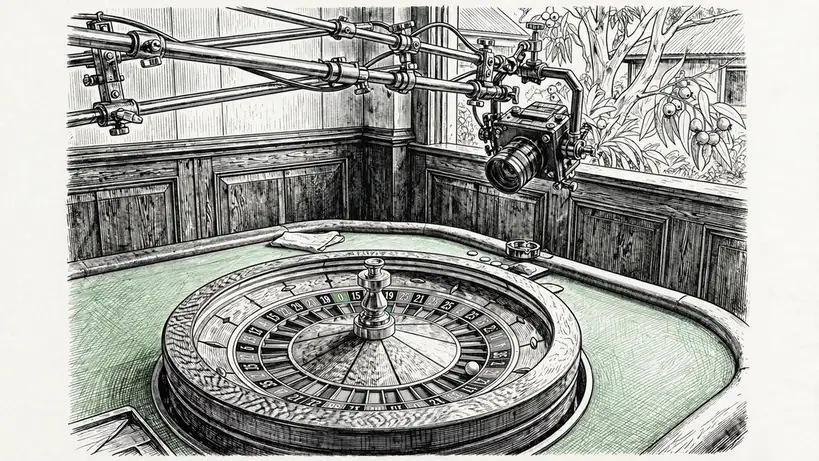
The live format does not alter the legal character of the service. A streamed dealer, a physical wheel located outside Australia or an interactive table displayed in an application is still an online casino service when made available to an Australian customer. Location of the studio is not a substitute for an Australian authorisation, and the presence of a real dealer does not move roulette into the sports-wagering category.
This is a useful boundary because live casino products can appear more like a broadcast than a conventional online game. Legally, the delivery method is not the controlling feature. The service remains within the prohibited category if it allows online participation in roulette for real money.
Blackjack and table-game variants
Blackjack is treated in the same way. A software-based table, a live dealer room and a version with modified side bets are all forms of online casino gaming when the service enables real-money play for an Australian customer.
Changes to rules, graphics or table layout do not create an Australian online licence category. A provider cannot convert blackjack into a permitted service by adding a live host, changing the name of the table or placing the operating company overseas. The restriction follows the product supplied to the Australian market.
The same reasoning applies to closely related table-game formats. The rule is not limited to one particular blackjack interface. It addresses online casino services as a class, with blackjack expressly included among the examples of prohibited interactive gambling services.
Live dealer tables
Live dealer tables are sometimes presented as a separate product because the game is conducted by a person in a studio rather than generated entirely by software. For Australian customers, that distinction does not make the service lawful.
A live dealer table typically combines a video stream, an online account and a mechanism for placing real-money wagers. Whether the table offers blackjack, roulette or another casino game, the combination remains an online casino service. The physical dealer and studio may be located in another country, but that fact concerns the provider’s operating arrangement, not permission to serve customers in Australia.
The practical classification is straightforward:
| Product format | Treatment when offered online to an Australian customer |
|---|---|
| Digital pokies | Prohibited interactive gambling service |
| Online roulette | Prohibited interactive gambling service |
| Online blackjack | Prohibited interactive gambling service |
| Live dealer roulette or blackjack | Prohibited interactive gambling service |
The table does not identify lawful alternatives. It maps the products covered by the restriction.
Product names do not change the rule
Casino services may use different labels for substantially similar products. “Instant games”, “table games”, “live casino” and “gaming room” can describe different interfaces, but a new label does not establish a new legal status. Classification depends on what the service allows, rather than the marketing language attached to it.
The same applies to a service that combines casino games with other forms of wagering. If a platform offers sports betting and online blackjack in the same account, the legality of the sports-betting component does not extend to the blackjack component. Each product must be assessed on its own regulatory basis. A lawful wagering product cannot serve as a blanket approval for prohibited casino games.
This distinction also prevents a common accounting error: treating an operator’s licence as an asset that covers every product on its website. A licence for sports or race wagering is not a casino licence. The product determines the relevant rule.
What the rule means for the player
The Interactive Gambling Act targets the provider rather than the player. Australians do not commit a crime merely by placing bets at offshore sites. That point does not make the underlying online casino service lawful, and it does not give the player the protections attached to a permitted Australian gambling product.

The legal exposure is directed at the supply of the prohibited service. Consumer risk remains a separate calculation involving access, withdrawals, account disputes and the absence of a domestic online casino licensing framework. Those issues do not change the classification of pokies, roulette, blackjack or live dealer tables; they explain why the distinction between a legal wagering product and an offshore casino service matters financially.
The result is precise rather than broad: online sports betting may operate through state and territory licensing arrangements, but online pokies, roulette, blackjack and live dealer casino tables offered to Australian customers are prohibited interactive gambling services. Interface, branding and dealer location do not alter that outcome.
Casino Sites and Apps: Licence Checks Without Australian Approval Claims
A licence badge on a casino site is not evidence of permission to serve Australian customers. The first distinction is between an Australian wagering licence and an overseas authorisation. They belong to different regulatory systems, cover different products and produce different legal outcomes.
Australian gambling regulation is divided between the federal government and the states and territories. The Australian Communications and Media Authority (ACMA) publishes a register of Australian-licensed interactive wagering service providers. That register is relevant to licensed wagering products, such as sports and race betting. It is not an Australian approval list for real-money online casino games.
No Australian gambling licence exists for casino games because offering that product to Australians is against the law. Consequently, an online casino site or app cannot establish a lawful Australian casino status by displaying a domestic licence number. There is no local casino licence of that kind to display or verify.
What an Australian register can and cannot show
The ACMA register should be read as a register of Australian-licensed interactive wagering service providers, not as a directory of casino sites. A listing can indicate that an operator holds a relevant Australian wagering authorisation. It does not convert casino games into an authorised product.
Licence Verification
Find the exact legal entity name in the site’s licensing information.
Take the licence number and the regulator’s name to the official regulator’s website.
Confirm if the licence actually covers online casino games or just other activities like wagering.
That distinction matters because gambling products are licensed separately from the general concept of “gambling”. An operator may be authorised for sports or race wagering while having no authority to provide pokies, roulette, blackjack or live dealer tables online to Australian customers. A site’s presence in a wagering register therefore cannot support a claim that its casino section is Australian-approved.
The same caution applies to branding. References to Australian regulation, local customer support or Australian payment processing do not replace a product-specific licence. Nor does a statement that an operator is “regulated” identify the regulator, the jurisdiction or the activities covered. A compliance review needs all three.
A useful record check therefore starts with the exact legal entity and the exact licence category:
- Identify the entity named in the site’s legal or licensing information.
- Note the licence number and the regulator said to have issued it.
- Check that number on the regulator’s official website.
- Compare the registered entity with the company operating the site or app.
- Confirm what product the licence covers and where the service may be offered.
If the information cannot be matched, the badge is only a claim made by the website. It is not independent evidence.
Foreign licences are not Australian approval
Offshore operators commonly hold licences from Malta or Curacao rather than an Australian casino licence. The Malta Gaming Authority (MGA) and Curacao eGaming maintain public registers where a licence number and its status can be checked. Those registers can help establish whether a foreign licence exists and whether the named entity appears in the relevant foreign record.
They do not, however, authorise online casino service to Australian customers. A Maltese or Curacao licence is an overseas regulatory record. It does not override the Interactive Gambling Act 2001, create an Australian casino licence or place the operator on the ACMA register.
This is the point at which many site descriptions become deliberately imprecise. “Licensed casino” may mean licensed somewhere, while the reader may reasonably understand it as licensed for the Australian market. Those are different statements. The accurate wording must identify the issuing jurisdiction and avoid implying Australian approval.
The practical result is straightforward:
| Record or statement | What it may establish | What it does not establish |
|---|---|---|
| ACMA register entry | An Australian interactive wagering authorisation may exist for the named provider | Australian approval for online casino games |
| MGA register entry | A Malta-related licence record may exist for the named entity | Permission to provide online casino games to Australians |
| Curacao register entry | A Curacao licence record and status may be available | An Australian gambling licence |
| Licence badge on a site | The operator claims regulatory coverage | That the claim is current, complete or valid in Australia |
A register check is therefore a verification step, not a recommendation to use the service. It confirms the status of a record; it does not remove the Australian legal restriction on online casino provision.
Apps require the same scrutiny
An app does not receive a different legal status because it is distributed through a mobile interface. The relevant questions remain the identity of the provider, the product supplied, the licence claimed and the customers targeted.
An app can display a foreign licence in the same way as a website. It can also use an abbreviated company name, a separate trading name or a parent-company reference. These details should be reconciled before treating any licence information as reliable. A mismatch between the app’s operator, the licence holder and the register entry leaves the legal position unverified.
App-store availability is not a gambling licence either. A download listing may show that software is technically available, but it does not prove that the underlying casino service is authorised for Australian residents. Distribution and gambling regulation are separate matters.

The same applies to geolocation language. A site may state that it accepts Australian customers, display Australian currency or use Australian-themed advertising. None of those features supplies the missing domestic casino authorisation. In a restricted market, commercial availability is not the same as lawful availability. That distinction is not semantic; it determines whether the provider is offering a prohibited service.
The correct wording for licence claims
Descriptions of casino sites and apps should avoid phrases such as “Australian-licensed casino”, “ACMA-approved casino” or “licensed for Australian players” unless a specific Australian casino licence actually exists. In this market, no domestically licensed real-money online casino exists for Australian players.
A precise description can state that an operator claims, or appears to hold, a licence from a named foreign authority, provided the claim is checked against that authority’s public register. It must then state the limit clearly: the foreign licence does not authorise the operator to provide online casino games to Australian customers.
That wording also prevents a common category error. A foreign register can answer, “Does this licence record exist, and what is its status?” It cannot answer, “Is this casino lawful for Australian customers?” The second question is governed by Australian law, not by the foreign regulator’s register.
ACMA’s role is separate again. ACMA monitors compliance with and enforces Australia’s interactive gambling laws. It can direct internet service providers to block sites operating in breach of the Interactive Gambling Act. A site being accessible at one moment is therefore not proof of approval, permanence or legality.
The financial consequence of weak licence language is clear: a badge may describe a foreign relationship, while the actual Australian position remains unchanged. For casino sites and apps, verification must begin with the product and the Australian market, not with the most prominent logo on the homepage.
Bonuses and Promotions: Why the Offer Is Not the Main Question
A casino bonus does not change the legal status of the service attached to it. Under the Interactive Gambling Act 2001, gambling providers cannot offer certain online services to people in Australia. Online casino promotions therefore have to be assessed as part of the provider’s business model, not as isolated marketing messages.

The practical distinction is straightforward: an offer may describe extra funds, free play or another inducement, but promotional wording cannot create an Australian right to receive a prohibited service. A banner, landing page, app notification or email does not become lawful because it uses terms such as “welcome”, “reward” or “VIP”. The commercial label is irrelevant if the underlying activity is an online casino service offered to an Australian customer.
The offer follows the service
A bonus is not a separate product. It is normally attached to an account, a deposit, a game or a wagering condition. That makes the provider’s legal position the first question. The value of the promotion, its presentation and its conditions are secondary if the service itself cannot lawfully be offered in Australia.
This matters because casino advertising often places the inducement at the centre of the message. The headline may emphasise a reward while leaving the provider’s status in small print or omitting it entirely. That reverses the order of analysis. The relevant sequence is:
- identify the service being offered;
- establish whether the provider may offer it to Australian customers;
- examine the promotion only if the underlying service is lawful.
For online casino activity, the first step is decisive. No promotional structure can repair the legal defect.
Why promotional language can mislead
Terms used in casino marketing frequently make a transaction appear more favourable than it is. “Matched deposit”, “free spins”, “cashback”, “reload”, “no-deposit reward” and “VIP benefit” are commercial descriptions, not evidence of legality. They say what the provider is prepared to offer, not whether the provider is permitted to offer it to Australians.
The same applies to claims about “licensed play”, “regulated withdrawals” or “secure rewards”. A foreign licence may describe the provider’s position in another jurisdiction, but it does not authorise online casino service to Australian customers. Promotional text cannot expand the scope of a licence. Nor can a reference to compliance, responsible gambling or identity checks substitute for permission under Australian law.
A regulated appearance is therefore not the same as an Australian legal basis. The distinction is less dramatic than the advertising suggests, but considerably more important.
Consumer risk sits behind the headline
Bonus conditions also create a separate consumer-risk issue. A promotion may be presented as money added to an account, while the actual benefit depends on conditions imposed by the provider. Those conditions can affect whether the balance may be used, withdrawn or cancelled. The precise terms matter, but they do not alter the provider’s obligation to comply with Australian law.
This produces two different questions:
- Legal question: may the provider offer the online casino service to a person in Australia?
- Commercial question: what conditions govern the advertised reward?
The second question cannot be used to avoid the first. A clear explanation of a bonus does not make an unlawful service lawful. Conversely, vague or aggressive promotional language can increase consumer risk without being the original source of the legal problem. The offer is simply the most visible part of a wider provider-customer relationship.
The provider, not the player
The Interactive Gambling Act targets the provider rather than the player. Australians are not committing a crime merely by placing bets at offshore sites. That allocation of responsibility does not turn offshore casino promotions into approved Australian offers, however.
The distinction is important in evaluating bonus advertising. A customer may see an offer, open an account or attempt to use a promotion without being the party targeted by the prohibition. The provider remains responsible for whether it supplies a prohibited online service to an Australian customer. The absence of criminal liability for the player should not be confused with approval of the operator or its advertising.
In financial terms, the customer may still face exposure even where the legal prohibition is directed at the provider. A promotional balance can depend on account rules, service availability and the provider’s willingness to process the associated activity. The advertised benefit is therefore not an asset equivalent to cash merely because it appears beside a monetary figure.
What a responsible assessment should exclude
A compliance-focused assessment should not reproduce inducements as shopping options. Listing casino bonuses, comparing rewards or directing traffic to promotional pages would turn analysis into promotion. It would also imply that the principal issue is which offer is most attractive, when the legal question comes first.
The safer editorial approach is to describe the function of the promotion without presenting it as an opportunity:
- a deposit-linked reward is an inducement connected to account funding;
- a free-play message is a marketing device connected to gambling activity;
- a loyalty benefit is part of the provider’s customer-retention model;
- a cashback claim is a commercial condition whose value depends on the provider’s rules.
None of these descriptions endorses the service. Each keeps attention on the provider’s conduct and on the limits of the offer.
No link, call to action or sign-up instruction is required to explain the issue. In this market, publishing promotional material for prohibited or unlicensed interactive gambling services can itself create regulatory risk. A description that helps evaluate legality is materially different from copy designed to increase registrations.
A bonus cannot substitute for lawful access
The central calculation is simple. If the provider cannot lawfully offer the underlying online casino service to an Australian customer, the bonus has no power to change that result. Its wording may be attractive, its terms may be detailed and its presentation may resemble a regulated financial product. The legal position remains unchanged.
Casino bonuses should therefore be treated as evidence of how a provider seeks to acquire or retain customers, not as evidence that the provider is authorised in Australia. The offer is a commercial layer. The provider’s legal authority is the governing condition.
Deposits and Withdrawals Under a Restricted Online Casino Model
Payment questions cannot be separated from the legal status of the service being paid for. Australia has no domestically licensed real-money online casino for Australian players. The restricted market is therefore not a normal comparison between deposit methods, withdrawal speeds and transaction fees. It is a situation in which the underlying casino service is not authorised to accept Australian customers.
That distinction changes the financial analysis. A payment option may appear on an offshore casino’s website, but its availability does not establish that the casino may lawfully provide online pokies, roulette, blackjack or live dealer games in Australia. Nor does the presence of a foreign licence convert the transaction into a domestically approved gambling payment. The payment rail is only one part of the arrangement; the legal status of the gambling provider remains the controlling issue.
Why a visible payment method proves little
Offshore casinos may display bank transfers, electronic wallets or other payment routes in an Australian-facing cashier. The display can create the impression that deposits and withdrawals are routine. It does not provide the protection associated with an Australian gambling licence, because no Australian licence exists for casino games.
Access Risk Attention A visible payment method does not guarantee access; ACMA can direct ISPs to block sites, making your account and funds inaccessible.
The same applies to a foreign regulatory record. Offshore operators commonly hold licences from Malta or Curacao, and the relevant authorities maintain public registers. Those registers can confirm whether a licence number exists and whether its status is recorded. They cannot show that the operator is authorised to provide online casino services to Australian residents. A foreign licence and Australian permission are separate questions, with different answers.
This is the point at which payment language often becomes misleading. “Accepted” may describe a technical capability. It does not mean lawful, protected or guaranteed. “Withdrawal available” may describe a term in an operator’s contract. It does not remove the possibility that the account, website or payment route becomes inaccessible before the transaction is completed. The wording is operational, not a substitute for regulatory approval.
Deposits carry a different risk from ordinary wagering payments
Licensed Australian wagering exists for sports and race betting, while online casino games are prohibited. A deposit intended for an offshore casino therefore cannot be assessed as though it were funding a licensed local product. The absence of a domestic casino licence affects the entire chain: account opening, identity checks, deposit acceptance, game access, account restrictions and withdrawal processing.
A payment dispute may also be harder to resolve when the provider is outside Australia. The relevant contract, regulator and customer-support process may sit in another jurisdiction. Australian consumer protections cannot be assumed merely because the website accepts Australian dollars, uses Australian language or markets itself to Australian residents. Currency presentation is a commercial setting, not evidence of local authorisation.
The practical calculation is simple: the value placed at risk includes not only the intended stake, but also the possibility that access to the account or payment channel is interrupted. That risk cannot be reduced to a comparison of transaction charges. A low-cost deposit is still exposed to the legal and operational status of the service receiving it.
Withdrawals are not a separate safe zone
A completed deposit does not create a right to an uninterrupted withdrawal process. Offshore casinos may impose account checks, review transactions or restrict access under their own terms. In a market where the service itself is not domestically licensed, the main issue is not which withdrawal route looks fastest. It is whether the provider remains available and whether a dispute can be pursued effectively if funds are held, an account is closed or a site is blocked.
ACMA can direct internet service providers to block websites operating in breach of the Interactive Gambling Act. A blocked domain can affect access to account pages, payment instructions and customer-support channels at the same time. A withdrawal request does not exempt a website from enforcement. A pending balance does not turn a prohibited service into a lawful one.
ACMA’s enforcement figures show why availability should not be treated as permanence. One reported position states that, as of August 2025, ACMA had blocked 1,296 illegal sites and affiliates since 2019. Another reported position states that, as of March 2026, ACMA had directed ISPs to block 1,564 illegal gambling and affiliate websites. These figures come from different reporting points and should not be silently treated as one continuous total. They indicate the scale of blocking activity, not a guarantee that any particular payment account will remain accessible.

More than 220 illegal gambling services have also been reported as having voluntarily exited the Australian market following ACMA action. Again, the financial consequence is direct: a service can stop accepting Australian customers without preserving the convenience of an existing cashier or providing the certainty associated with a local licence.
Enforcement affects the payment environment
Blocking action is directed at websites and services, not at creating a lawful pathway for casino deposits. The Interactive Gambling Act targets the provider rather than the player. Australians are not committing a crime merely by placing bets at offshore sites, but that does not make the provider authorised or make the transaction risk-free.
Reports indicate that the amount of money Australians lost on gambling services based outside Australia has reduced since the reforms. That result is consistent with a market in which enforcement disrupts access and reduces the flow of funds to offshore providers. It should not be read as proof that remaining payment routes are reliable. Reduced losses and successful withdrawals are different measures.
The payment question should therefore be framed narrowly. There is no domestically licensed real-money online casino whose deposits and withdrawals can be compared with those of local wagering operators. Any offshore payment arrangement exists within a restricted and enforceable environment. A method shown on a cashier may function technically while the wider service remains unauthorised for Australian customers.
For financial-risk purposes, the relevant facts are the provider’s legal position, the possibility of access being blocked and the absence of a domestic casino regulator responsible for resolving the transaction. Treating a deposit button as evidence of approval confuses a website feature with a legal status. In this market, that is an expensive distinction.
Written by the editors at Australia Betting Info.